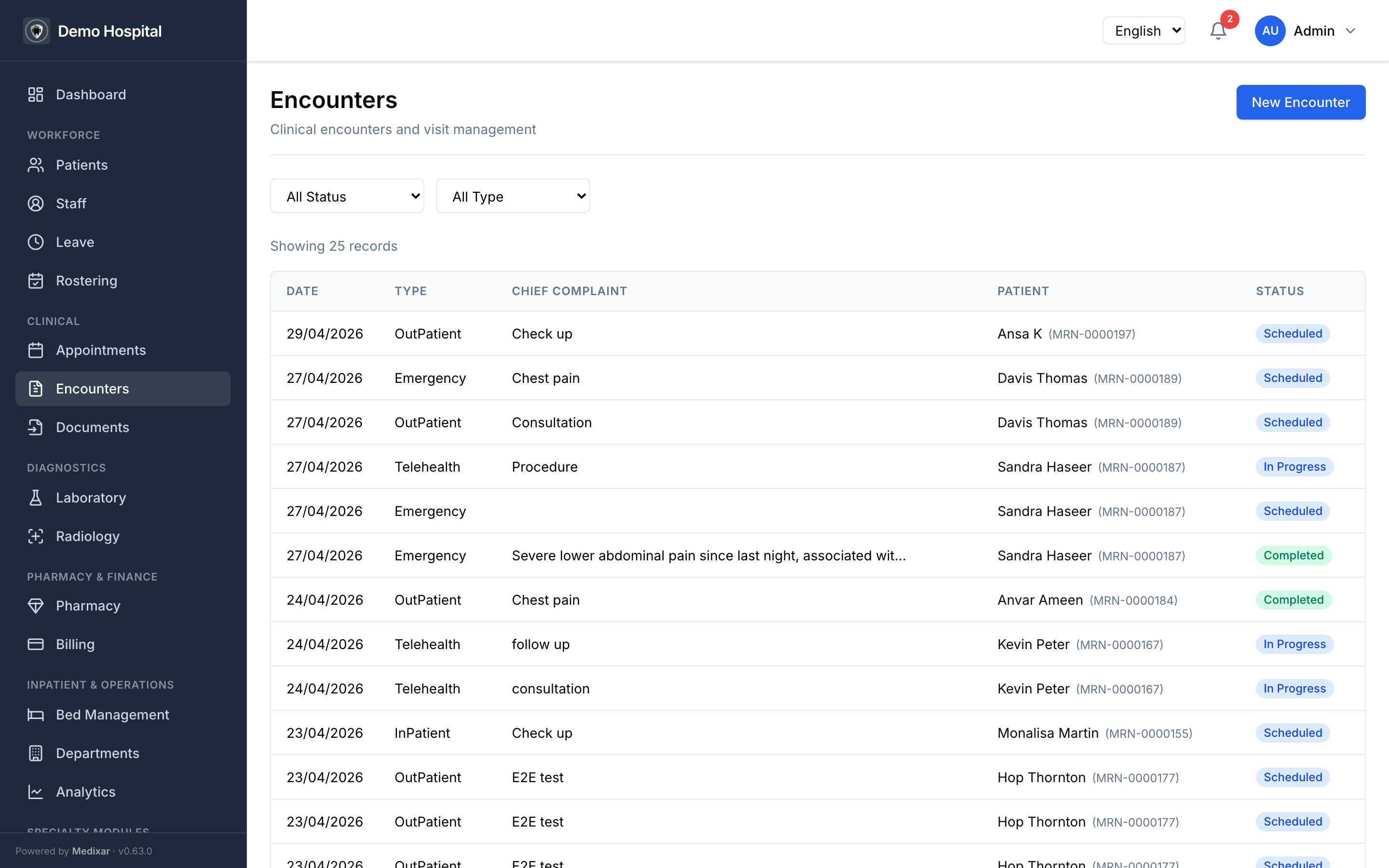
The encounter, end to end
A Medixar encounter holds the eight things a clinician actually wants in one place:
- Chief complaint & history — free text or voice-to-SOAP draft.
- Vital signs — auto-flagged abnormal values; trend over visits.
- Examination — system-by-system findings, structured.
- Diagnoses — ICD-10 (and ICD-11 TM2 for AYUSH), with AI-suggested codes.
- Medication orders — fail-closed drug-interaction checks before sign.
- Lab & imaging orders — generated from the encounter, results land back.
- Care plan & follow-up — patient-facing instructions printed automatically.
- Documents — discharge summaries, ABHA-bound consent, prescriptions.
Section-level autosave with optimistic-locking version columns means two clinicians can work on the same encounter (a junior writes the history while the consultant adds the assessment) without one overwriting the other. The system surfaces conflicts with a diff modal — you choose which version to keep, every time.
Append-only audit on every clinical write
Every read of a finalised clinical record writes a HIPAA §164.312(b) audit row with the user UUID, tenant, timestamp, and reason. The audit table is append-only at the database layer — even our own engineers cannot retroactively edit it. This is what NABH, JCI, and DPDPA all want to see, and what most EMRs in the Indian market silently lack.
The IPD chart, on the same record
A patient who moves from OPD to IPD does not need a different system. Admission, ward assignment, MAR (medication administration record with BCMA + double-check on high-risk medications), nursing notes, and discharge summary all live in the same encounter chain. Length-of-stay reporting, readmission tracking, and bed-management dashboards read from the same source of truth.
AYUSH, first-class
The clinical workspace is not allopathic-with-a-Sanskrit-dropdown. AYUSH systems — Ayurveda, Homeopathy, Unani, Siddha, Yoga, Naturopathy, Sowa Rigpa — each have their own assessment surface (Prakriti / Mizaj / Mukkutram / Nyepa), their own consultation form, their own pharmacopoeia. Cross-system safety runs nine interaction backends in parallel. Detail on the AYUSH page.
What it looks like for the clinician
- One screen per consult. Tab through sections; no nested modals.
- Voice-to-SOAP draft on tap. Speaking-to-saved-note in under 90 seconds in our beta.
- One-tap finalise. Encounter locks; downstream events fire (claim, discharge, follow-up).
- Amend with audit. Post-finalise corrections go through an addendum workflow that preserves the original.
What it looks like for the practice owner
- One audit log. NABH evidence is a query, not a month-long export.
- Real specialty data. Top diagnoses, missed-coding patterns, encounter-to-claim time.
- Consent & ABDM. ABHA verification at intake; consent artefacts captured automatically.
Migrating from your current EMR
We have moved 80+ clinics off four major Indian-market EMRs. The migration uses bulk import for past encounters (read-only-archived in Medixar) and a clean cut for new encounters from go-live. Nobody loses access to historical records.