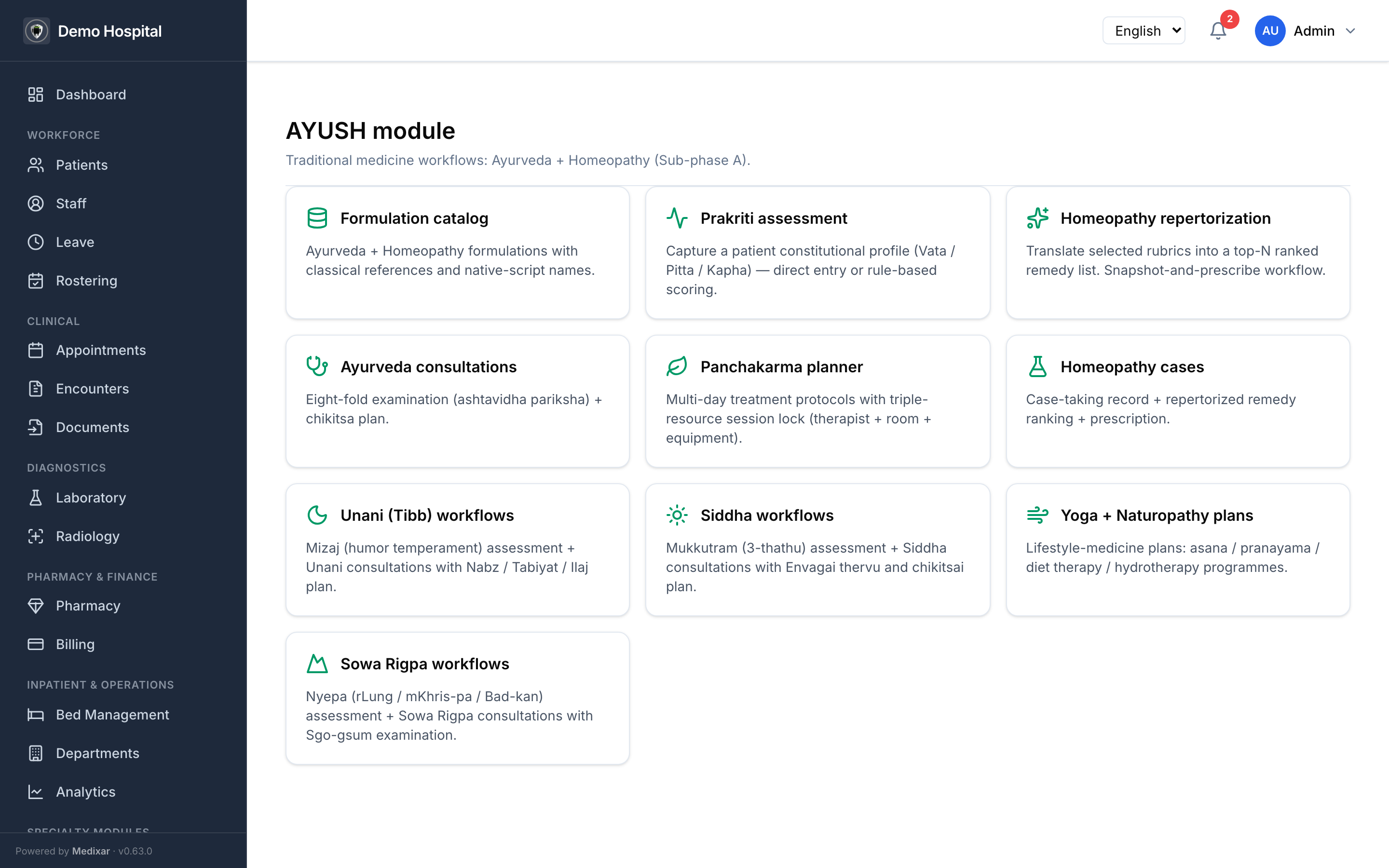
The seven systems, first-class
Each system has its own assessment surface, its own consultation form, its own prescription model, and its own pharmacopoeia. They share the patient and the audit trail; they do not share a generic "AYUSH" template that pretends Ayurveda and Homeopathy are the same thing.
Ayurveda
Prakriti (V/P/K) assessment, ashtavidha pariksha, chikitsa plan, ICD-11 TM2 + ICD-10 side-by-side, Bhasma batch tracking with QC for NABH-AYUSH compliance.
Homeopathy
Totality of symptoms, repertorisation with pre-computed inversion, top-N ranked remedies, potency and repetition rules, snapshotted ranking for case reproducibility.
Unani
Mizaj assessment (four humors), ilaj-bil-tadbeer regimen, Unani prescriptions tied to humor balance.
Siddha
Mukkutram (three thathus) assessment, Siddha consultations, Siddha prescriptions with thathu-aware therapeutics.
Yoga & Naturopathy
Combined therapy plans (asana, pranayama, hydrotherapy, mud therapy, fasting, massage, diet) — multi-tag because the two systems are co-prescribed in practice.
Sowa Rigpa
Nyepa (rLung / mKhris-pa / Bad-kan) assessment, Sgo-gsum examination, Sowa Rigpa consultations.
What Medixar does that allopathic-with-a-Sanskrit-dropdown can't
Cross-pharmacopoeia interaction safety
A patient on a long-term Ayurveda Bhasma also gets a homeopathy remedy from a different practitioner in the same hospital. Allopathic-only interaction tables miss this entirely. Medixar runs nine interaction backends — system-internal, system-temperament, and cross- system — in parallel, and fails loud on any partial backend failure rather than silently passing. This is a deliberate safety posture: a missed interaction is worse than an extra warning to acknowledge.
Bhasma batch tracking for NABH-AYUSH
Heavy-metal preparations (Bhasma) demand a paper trail: shodhana rounds, marana puta count, bhavana cycles, source raw materials, AAS / ICP-MS QC reports, expiry, dispense ledger. Medixar persists every gate as a structured record. Dispense is gated by QC pass + non-expiry + sufficient quantity, with structured error codes the UI can branch on without parsing natural-language prose.
ICD-11 TM2 master catalog
The ICD-11 Traditional Medicine module 2 (TM2) is the WHO's mapping of traditional medicine concepts into the ICD framework. Medixar ships the curated TM2 catalog with the AYUSH module, so consultations carry both ICD-10 (for insurance) and ICD-11 TM2 (for research, integration, and longitudinal care) without the practitioner re-keying anything.
Per-system tenant toggles
A pure Ayurveda clinic does not need the Sowa Rigpa surface cluttering the UI. A multi-system AYUSH hospital needs all seven. Medixar's tenant feature flags let you turn on exactly the systems you practise — the rest of the UI stays clean. New systems can be toggled on later without a re-deployment.
AI-assisted Prakriti scoring
Optional AI-assisted Prakriti scoring uses an in-house FastAPI microservice; if the model is unreachable, the system fails soft to a rule-based scorer (the opposite posture from interactions). Prakriti is informational, not safety-critical — degraded accuracy is better than degraded availability.
Built for the realities of Indian AYUSH practice
- UTF-8 native script support — Devanagari, Tamil, Malayalam, Nastaliq round-trip without corruption.
- Practitioner credentials — AYUSH-specific credential types (BAMS, BHMS, BUMS, BSMS, BNYS, etc.) with expiry alerts.
- Atomic prescription numbering — RX-YYYYMMDD-NNNNNNN format, monotonic per tenant, NABH-audit-friendly.
- Six AYUSH-specific roles — AyurvedaDoctor, Homeopath, PanchakarmaTherapist, YogaInstructor, AyushPharmacist, AyushAdmin.
- 21 fine-grained AYUSH permissions — your front desk does not need to see your case-taking notes.
- Structured BDD scenarios for every workflow — your QA / NABH team gets the test pack on day one.
Panchakarma, properly
Panchakarma in Medixar is a real workflow, not a free-text field. Plans encode purvakarma → pradhanakarma → paschatkarma. Sessions lock therapist + room + equipment with predicate- based concurrency control — two coordinators cannot double-book the same therapist for overlapping windows. Cancelled / no-show statuses are excluded from the lock so a cancelled slot frees the therapist immediately.
Recommended plan
Most AYUSH clinics start on the Clinic tier with the AYUSH module enabled (an add-on). Multi-system AYUSH hospitals or integrated AYUSH-allopathy facilities get the Hospital tier with all systems on by default. The launch offer — 50% off for 12 months for the first 50 clinics — applies.