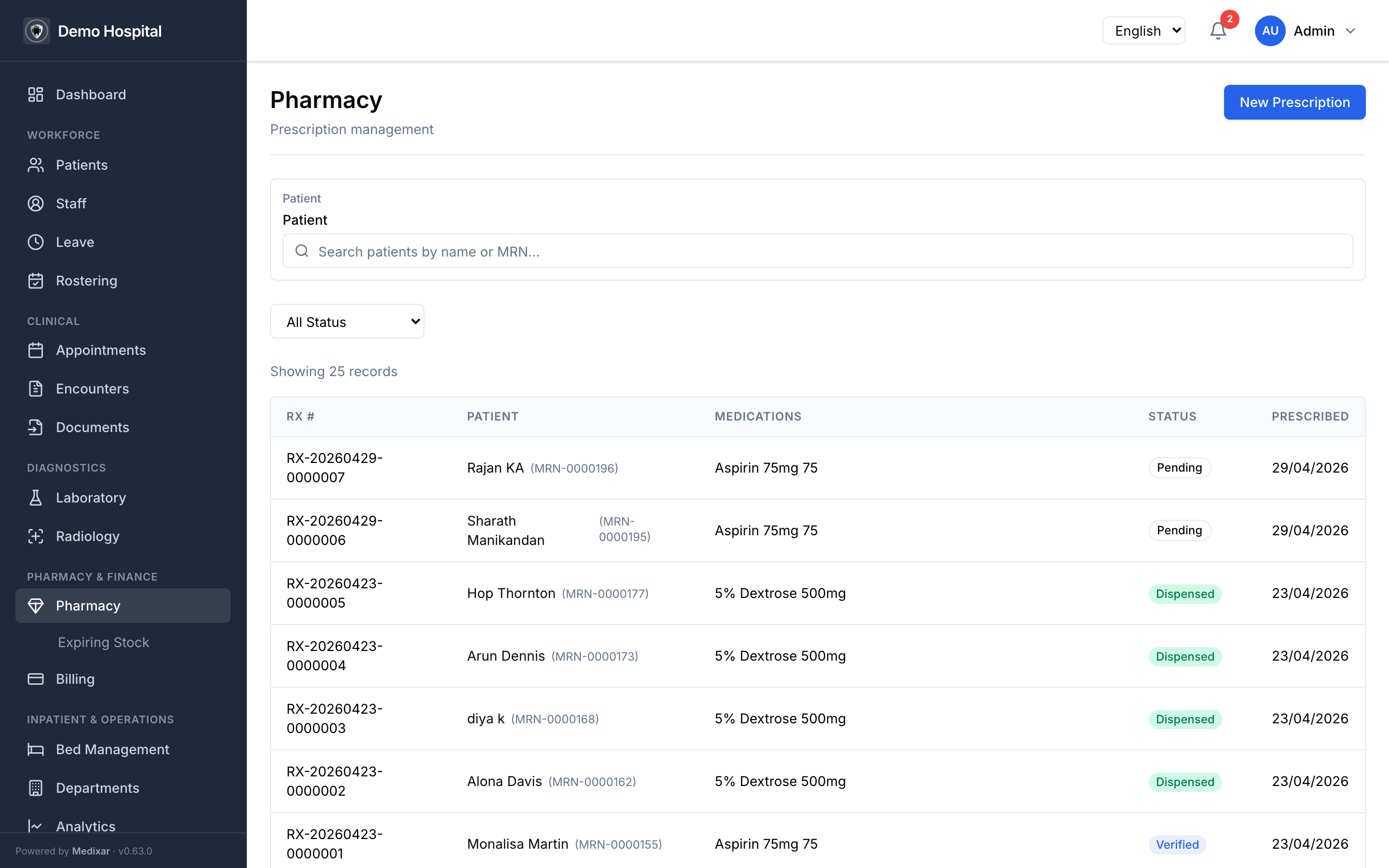
E-prescribing with safety guard rails
Every prescription runs three checks before it can be signed:
- Drug-interaction screen against a curated catalog of major and severe interactions. The check fails closed — if the database is unreachable, the prescription cannot be created. Better to refuse than to silently miss.
- Allergy check against the patient's documented allergies. The model looks for ingredient overlaps, not just brand-name matches.
- Override workflow with audit — if the doctor knowingly proceeds despite a warning, the override carries a structured reason and the user UUID. NABH and JCI auditors can see exactly who overrode what and why.
FEFO inventory — first-expired-first-out
Pharmacy inventory is tracked at the batch level (not just SKU). When a dispense is recorded, Medixar atomically picks the batch with the soonest expiry that has sufficient stock. No partial dispenses; no race conditions; no manual batch picking by the pharmacist.
Expiring stock alerts surface 90 / 60 / 30 / 7 / 0 days out so nothing expires unnoticed. Stock returns reverse the dispense atomically.
Atomic dispense
A dispense is a single SQL transaction: the prescription status moves Verified → Dispensed, inventory decrements per linked item, the dispense receipt is recorded. If any step fails, the whole transaction rolls back. Two pharmacists can't dispense the same prescription twice; one dispense can't deduct stock from a batch that's already empty.
BCMA on high-risk medications
For inpatient medication administration, Medixar supports Barcode Medication Administration: scan the patient wristband, scan the medication, the system verifies the match and only then permits the dose. Mismatches hard-block with a clear error. Audit trail records every administration with the nurse UUID, timestamp, and barcode value.
AYUSH cross-pharmacopoeia safety
A patient on Ayurveda Bhasma also gets a Homeopathy remedy from a different practitioner in the same hospital. Allopathic interaction tables miss this entirely. Medixar runs nine interaction backends in parallel — system-internal, system-temperament, and cross-system — and fails loud on any partial backend failure rather than silently passing. Detail on the AYUSH page.
Bhasma batch tracking for NABH-AYUSH
Heavy-metal Ayurveda preparations (Bhasma) require a documented chain of custody: shodhana rounds, marana puta count, bhavana cycles, source raw materials, AAS / ICP-MS QC reports, expiry, dispense ledger. Medixar persists every gate as a structured record. Dispense is gated by QC pass + non-expiry + sufficient quantity, with structured error codes the UI branches on without parsing prose.
Inter-branch transfer
A multi-branch chain transferring stock between pharmacies records the transfer as a transactional pair: source decrement + destination increment, with a transit-state for stock in-flight. Lost shipments don't silently vanish from the ledger.
What it looks like for the pharmacist
- Dispense queue ranked by urgency (inpatient first, then walk-in).
- Search by patient name, MRN, prescription number, or barcode.
- Auto-print labels with patient name, dose, schedule, and pharmacist initials.
- Refill workflow — patient walks in with prior prescription, pharmacist verifies and dispenses.
What it looks like for the practice owner
- Real-time stock value across branches.
- Slow-mover and dead-stock reports.
- Margin per category, per supplier.
- Audit trail on every prescription, override, and dispense.